
Investment trends
Helping you to spot major market moves before they happen.

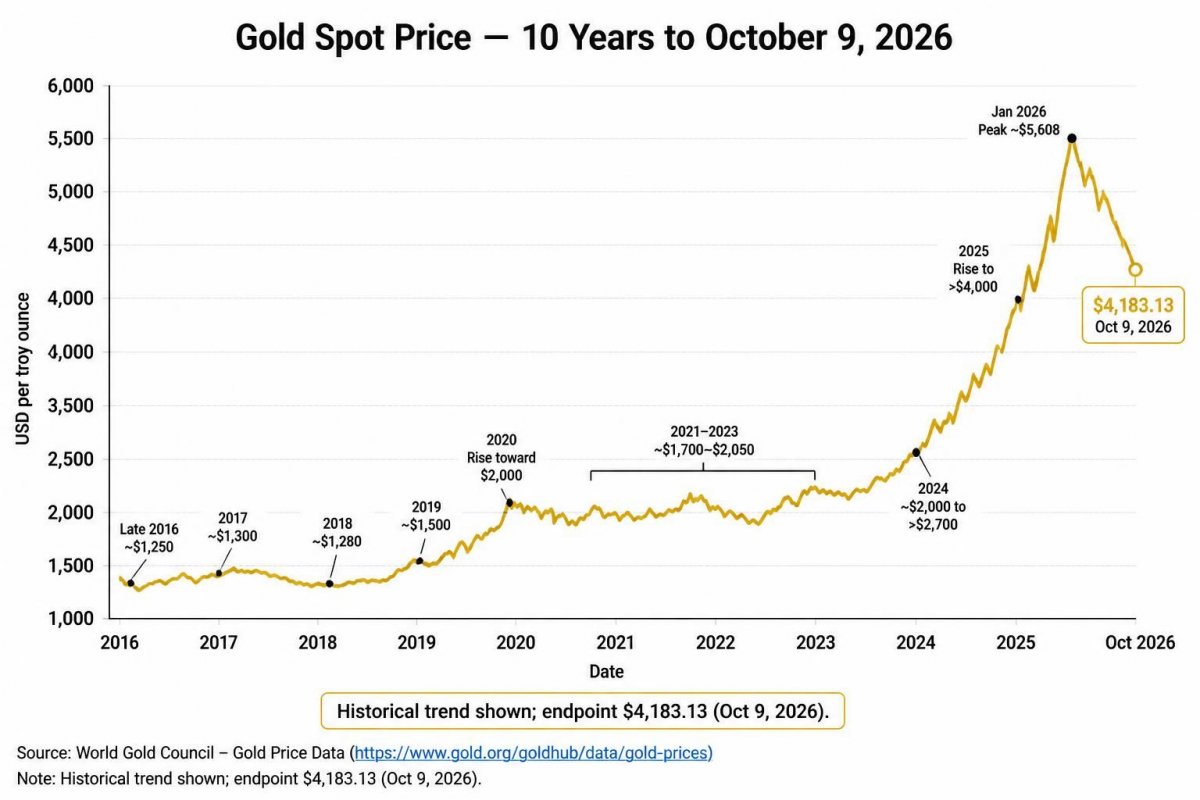
There's a good chance we will see an 'October turnaround' this year
The stock market so far this year.

The Dow Jones Industrial Average's performance year-to-date
OCTOBER 3, 2026
OVER MANY YEARS I NOTICED that in mid-October the stock market often changed direction. If stocks were trending upward in mid-October they reversed and went down. If they were going down they turned around and went up.
Part of the reason I noticed this trend was because my birthday is in mid-October. (Now there's a good rational investment principle!)
Of course, some years it failed to happen, but it clearly seemed to do so on a regular basis.
I wondered whether it was because money managers make annual investment decisions then. They look at the year-to-date returns on their stock investments and decide, on this basis, whether to take their profits and leave or whether to buy in because they see the chance of boosting their year-to-date returns.
Who knows? For whatever reason, however, I was convinced that the trend was real.
Hey, it IS real!
So I took a look at the trends over the past 20 years. Here's what the research showed.
I learned that in about 16 of the 20 Octobers from 2006 through 2025, a swing of more than 1% took place about 80% of the time in my birthday month. That breaks down to roughly:
- 12 or 13 Octobers with gains of at least 1%
- 3 or 4 Octobers with losses of at least 1%
- 4 Octobers with changes smaller than 1%
- 2008: −14% — financial-crisis selloff
- 2011: +9.5% — sharp rebound during the European debt crisis
- 2015: +8.5% — strong recovery after the summer market correction
- 2018: −5% — broad fourth-quarter selloff
- 2022: +14% — powerful rebound from bear-market lows
- 2023: roughly +5% to +6% — recovery after weakness earlier in the year
Next two weeks
The key now is to watch the markets in the next two weeks. So far since August the trend has been downward. If this trend continues over the next two weeks, or even if the markets are flat, the scene seems to be set for a mid-October upturn. If, however, the market rises sharply over the next two weeks, we might see a reversal downward in mid-October.
Of course, as always, no one can predict the future. But, judging by historical trends, we can always try.
— Graham Fysh
SEPT. 26, 2026
Are the markets flashing warning signs of a recession?
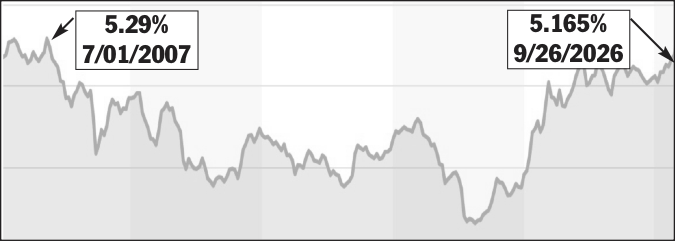
How the yield on the 10-year Treasury has performed over the last 19 years. Note the recent rise above 5% is the first since 2007.

How the Dow Jones Industrial average performed from 2007 to 2010. The average plunged 53.78% over about 18 months.
IN JULY 2007 the 10-year Treasury yield peaked at 5.29%. Six months later, in December, the Great Recession began, according to the National Bureau of Economic Research.
Over the following 18 months the Dow Jones Industrial Average reflected the recession, plunging 53.78%.
Now—for the first time since then—the 10-year Treasury yield is again above 5%.
Is history about to repeat itself?
After all, the yield has not risen above 5% over the almost 20 years that have passed since that scary time.
An earlier example
- The 10-year yield was above 5% around early 2000.
- The recession began in March 2001.
- Elapsed time: roughly 12–13 months.
You might be temped to believe that now that the 10-year Treasury yield has risen above 5% a recession will follow in the United States in more or less about a year.
Not a rule
This belief of an imminent crash is not based on a fixed historical rule, however.
A 10-year yield above 5% by itself does not reliably predict a recession or determine when one will begin.
After all, the 10-year Treasury yield rose well above 5% in 1994—reaching roughly 8%—during the 1994 bond-market selloff.
No U.S. recession followed; the expansion continued until the recession that began in March 2001.Indeed, the Federal Reserve specifically identifies the 1994 rate-hiking episode as a hiking cycle that did not end in a recession.
There are many other earlier examples of a failure for a recession to follow, because the 10-year yield remained above 5% for long stretches in the 1960s, 1970s, and 1980s without an immediate recession.
Then again...
But then again annual average yields were above 5% in 1967. The next recession began in December 1969—so the initial rise above 5% did not automatically cause a recession within a year, but one did follow not that long after.
The key take-away is that a 5% 10-year yield is not itself a reliable recession signal. The economic context and the yield curve—especially whether short-term rates rise above long-term rates—matter more than the absolute 10-year level.
It might, however, be a good idea now to plan ahead, hedge your bets and play it safe.
Just in case recent history does repeat itself...
— Graham Fysh
News of interest to investors and advisers

Americans changing jobs are losing track of earlier retirement accounts
ONE IN THREE AMERICANS may experience “retirement drift” — when retirement savings get fragmented, complicated, and harder to manage with each job change. A recent online poll of 2,005 U.S. adults, commissioned by Empower, found more than four in five (84%) have changed employers at least once in their career, and 39% have their retirement savings spread across multiple employers, making it difficult to track and manage.
Younger generations are more likely to lose track of retirement savings from previous employers: half of Gen Z (50%) and 45% of Millennials have lost track of old savings, compared to 30% of Gen X and 14% of Boomers.
Losing track might mean losing out
Fifty-four percent of respondents agreed that having retirement savings in multiple accounts makes it harder to plan for retirement. In fact, 40% worry they could lose track of their retirement over the course of their career.
According to 45% of respondents, managing their retirement savings becomes increasingly more complicated every time they change jobs. Yet, a majority of respondents (85%) believe leaving a job shouldn’t mean starting all over again with their retirement savings.
“Changing jobs is a normal part of a career, but our financial lives don’t always transition as neatly,” said Jane Bartosik, SVP, Wealth Solutions at Empower. “Deciding what to do with a 401(k) from a previous employer can take a back seat when you’re starting a new job and managing other financial priorities. These accounts can accumulate, making it harder to see your complete retirement picture and know what steps to take next.”
Many put off financial tasks
For many Americans, facing multiple retirement accounts makes consolidation daunting. Over half (57%) said they tend to put off financial tasks that seem complicated — this was especially the case for Gen Zers (69%). And as 54% find retirement planning more confusing than other areas of personal finance, just as many have put managing their retirement savings at the bottom of their financial to-do list. Nearly half (47%) have delayed dealing with retirement savings, such as initiating a rollover, because it felt overwhelming, including 58% of Gen Z and 57% of Millennials.
Sense of confidence and control
Having a clear view of retirement savings accounts can bring many a sense of confidence and control. A large majority (84%) said keeping their retirement savings organized gives them peace of mind, and nearly as many (83%) feel more in control when those savings are organized in one place. Three-quarters of respondents (76%) said that clear, step-by-step guidance would make them more likely to take action. Seventy percent also said they’d be more likely to act if they better understood the retirement options in front of them.
Prefer professional advice to AI
Nearly two-thirds (63%) believe AI and digital tools can make retirement planning easier for them. However, while 73% believe AI is a valuable complement to human, professional financial advice, it shouldn’t replace the human experience. In fact, 78% said for their important retirement decisions, they’d trust a financial professional more than they would AI.
When asked what would make them most likely to review or act on their retirement savings, respondents most often chose talking with a financial professional (22%) and approaching retirement (19%).
“The research shows how much Americans value having a sense of clarity and control when it comes to their retirement savings,” said Bartosik. “As working lives become less linear, that visibility can become even more important in helping people stay connected to the savings they’ve built over time.” Jobs change. Retirement planning doesn’t have to start over. Talking to a financial professional can help you learn more and better understand your options.

Google Pixel Watch
• Health tracking focus: Given your interest in healthy ways to battle stress, the Pixel Watch 4's stress tracking, heart rate monitoring, sleep insights, and SpO2, align well with your health-conscious lifestyle.
• Active lifestyle support: The watch offers advanced running plans, real-time form guidance, and GPS tracking — great for outdoor activities.
OUR BOOK SUGGESTIONS
BEST SELLER
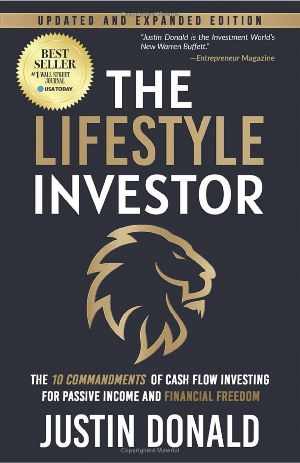
JOIN THE super-achievers experiencing wealth and freedom today! Entrepreneur Magazine calls Justin Donald the "Warren Buffett of Lifestyle Investing." He's a master of low-risk cash flow investing, specializing in simplifying complex financial strategies, structuring deals, and disciplined investment systems that consistently produce profitable results. His ethos is to "create wealth without creating a job."
In the span of 21 months, and before his 40th birthday, Justin's investments drove enough passive income for both he and his wife Jennifer to leave their jobs. Following his simple investment system and 10 Commandments of Lifestyle Investing©, Justin negotiated deals with over 100 companies, multiplied his net worth to over eight figures, and maintained a family-centric lifestyle in less than two years. Just two years later, he doubled his net worth again.
He now consults and advises entrepreneurs and executives on lifestyle investing. Justin hosts the podcast The Lifestyle Investor® featuring his lessons and proven investment system that consistently produces repeatable returns.
BEST SELLER
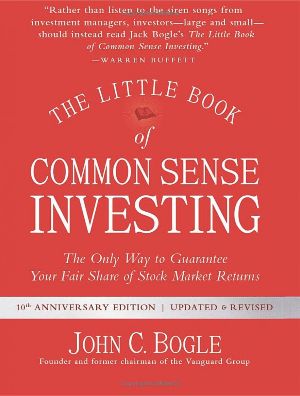
THE LITTLE BOOK OF COMMON SENSE INVESTING is the classic guide to getting smart about the market. Legendary mutual fund pioneer John C. Bogle reveals his key to getting more out of investing: low-cost index funds. Bogle describes the simplest and most effective investment strategy for building wealth over the long term: buy and hold, at very low cost, a mutual fund that tracks a broad stock market Index such as the S&P 500.
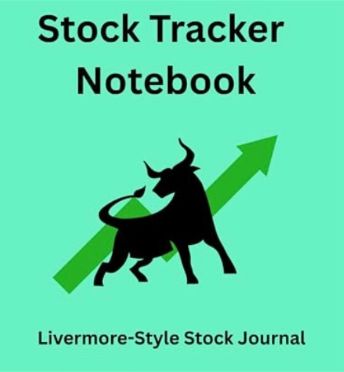
REDISCOVER THE DISCIPLINE and clarity of classic trading with the Livermore-Style Stock Journal — a clean, two-stock notebook inspired by the methods of legendary trader Jesse Lauriston Livermore.This handcrafted journal helps you slow down, observe, and record the true rhythm of the market — one line at a time. Each page is designed for two stocks, with six vertical columns per stock to capture every phase of price movement:
Secondary Rally, Natural Rally, Upward Trend, Downward Trend, Natural Reaction, and Secondary Reaction.
Perfect for traders, investors, and students of market psychology, this notebook brings back the art of handwritten charting — the way Livermore himself analyzed rallies, reactions, and pivotal points.
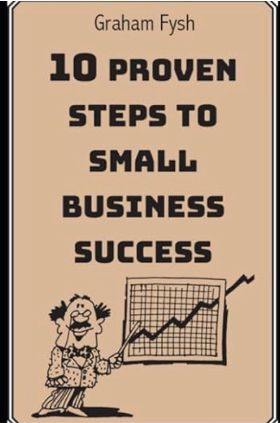
OVER 10 YEARS, journalist Graham Fysh interviewed 120 successful small businesses, researching in depth the factors that lay behind their profitable ventures. As he probed deeper, he found common strands that linked them. He found that the winning small business owners all had taken 10 steps that contributed to their success.
The steps are outlined in detail in this book. It is packed with real-life examples and case studies so the reader can see how the businesses applied the 10 steps to make their ventures successful.
These steps can work for you, too, whether your business is only a concept, a start-up or an established company seeking to advance. Indeed, 10 Proven Steps to Small Business Success is essential reading for all small business owners.
The steps are outlined in detail in this book. It is packed with real-life examples and case studies so the reader can see how the businesses applied the 10 steps to make their ventures successful.
These steps can work for you, too, whether your business is only a concept, a start-up or an established company seeking to advance. Indeed, 10 Proven Steps to Small Business Success is essential reading for all small business owners.